Voice AI decisions
AI Voice Agent vs IVR: What Changes for Callers, Cost and Setup
An IVR asks callers to press 1. An AI voice agent asks what they need and then does it. Here is when each one earns its place, with prices you can check.
By Shreyas Raj, founder of RapidXAI · Updated 29 November 2026 · 9 sources
The short answer
An IVR is a fixed phone menu that routes callers with keypad presses or a few keywords. An AI voice agent understands free speech, answers questions and completes tasks like bookings. IVR is cheaper per month (around ₹5,000 for an entry cloud plan in India) but most callers still end up with a human. An AI agent costs per minute (roughly ₹2 to ₹12 a minute depending on how it is built) and pays off when it actually finishes calls instead of forwarding them.
Sort vs solve: the whole difference in one table
An IVR sorts calls. An AI voice agent handles them.
That one difference drives everything else: what callers feel, what you pay, and what can go wrong.
| IVR (phone menu) | AI voice agent | |
|---|---|---|
| How the caller speaks | Presses keys or says one of a few words | Talks normally, in their own words and language |
| What it does | Routes to a queue, plays info, takes a PIN | Answers, books, qualifies, updates your CRM, transfers when stuck |
| Typical India price | Flat monthly plan, about ₹5,000 for an entry tier [3] | Per minute, about ₹2 to ₹12 depending on stack [4][5][6] |
| Setup time | Hours (draw the menu, record prompts) | Days to weeks (prompt, tools, testing) |
| Failure mode | Caller trapped in a loop, presses 0 | Agent mishears, guesses, or talks too long |
| Best at | Simple, fixed choices at huge volume | Open questions, bookings, after-hours, leads |
What callers actually think of phone menus
Callers do not hate automation. They hate being misunderstood.
A 2019 Clutch survey of 501 people found 88% prefer a live agent to a phone menu [1]. The top complaints were listening to options that had nothing to do with their problem (69%) and not being able to explain the issue (67%) [1].
And when a human is hidden? 70% just press zero, and 65% say a word like 'agent' [1]. (Your carefully designed 4-level menu is mostly a speed bump.)
Fresher data says the same thing. A June 2026 survey of 1,001 US consumers, run by Parloa, found only 7% say IVR consistently resolves their issue [2]. Another 45% said it sometimes helps but rarely fixes things [2].
The number one pain point in the 2026 survey was 'talking to a bot that doesn't understand me' [2]. That is a warning for AI agents too. A badly built AI agent is worse than a clean IVR, because it wastes more of the caller's time before failing.
Same survey: 60% of people will repeat themselves only once before giving up on an automated system, and 56% give it less than three minutes [2]. So the bar is not 'sounds human'. The bar is 'gets it right on the first try'.
Where the money really goes
Comparing a ₹5,000 IVR plan with a per-minute AI bill is the wrong fight. The menu is cheap. The humans behind it are not.
Clutch found 72% of callers always or often end up talking to a person after the menu [1]. So your IVR mostly decides which agent picks up. Your real cost is agent time.
Worked example: a clinic chain with 3,000 calls a month
Assume an average AI-handled call of 2 minutes, so 6,000 AI minutes a month. Prices are list prices as of November 2026, converted at about ₹94 to the dollar (the rupee closed at 93.92 on 16 November 2026 [9]).
| Option | Monthly cost (approx.) | What you get | How we got the number |
|---|---|---|---|
| Cloud IVR | ₹5,000 plus call charges | Routing only. Humans still answer most calls. | MyOperator entry (Sedan) plan, ₹5,000/month for 10 users [3] |
| AI agent on Vapi | ₹46,200 to ₹72,800 plus telephony | Full conversations, your choice of models | Vapi estimate of $82 to $129 per 1,000 minutes [4], x6 |
| AI agent on Retell | About ₹62,000 | Full conversations, managed platform | Retell sample rate of $0.11/min [5], x6,000 |
| Self-assembled stack (India telephony + Indian speech models) | About ₹12,000 to ₹18,000 plus hosting | Full conversations, you run it | Our estimate: Vobiz voice from ₹0.42/min [6], Sarvam speech-to-text ₹0.49/min [7], plus TTS and LLM |
On raw rupees, IVR wins every time (no surprise there).
Now flip it. If the AI agent fully resolves even half of those 3,000 calls, 1,500 calls never reach your front desk. That is the comparison that matters: AI minutes versus the staff hours it frees, not AI versus the menu.
If fewer than about a third of your calls could be finished without a human (pure complaints, complex billing, emotional conversations), keep the IVR and invest in staff. If most calls are bookings, timings, order status or lead questions, the IVR is costing you more than it saves.
When the humble IVR still wins
IVR is not dead. It is just over-used. Keep a menu when:
- The choice really is fixed. 'Press 1 for Hindi, 2 for English' is faster than a chat about language.
- You need keypad input. PINs, OTPs, account numbers and card digits are safer as key presses than spoken aloud in a busy shop.
- Volume is massive and value per call is tiny. A balance enquiry line taking 50,000 calls a day does not need a thinking model on every call.
- Compliance wants a fixed script. Some regulated flows need the exact same words every time, and a menu gives you that for free.
- Nobody will maintain the AI. An agent needs its prompt, knowledge and tools kept current. A menu can sit untouched for years (and often does).
When an AI voice agent wins
Switch to an agent when callers need a conversation, not a category.
- Bookings and reschedules. The agent checks the calendar and confirms a slot while the caller is still on the line.
- Lead calls. It asks budget, location and timeline, then writes the answers into your CRM. A menu cannot qualify anyone.
- After hours. Nights, Sundays and festival days are when menus send people to voicemail and leads go cold.
- Mixed languages. Callers who switch between Hindi and English mid-sentence break keyword IVRs. Indian speech models like Sarvam's are built for this mix [7].
- Questions with many possible answers. Timings, prices, documents needed, directions. A 9-option menu still misses half of them.
Speed matters here too. Synthflow, for example, advertises replies within half a second after the caller stops talking [8]. Whichever platform you test, measure that gap yourself on a real phone line, not in a browser demo. (Hint: it is usually the latency, not the voice, that makes callers hang up.)
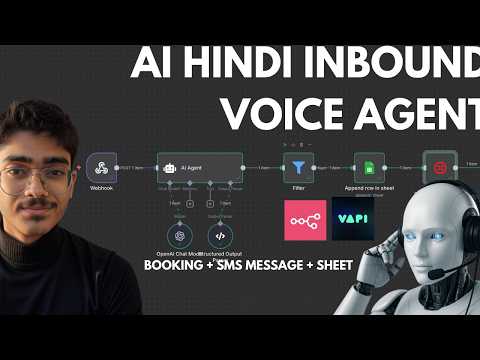 Build an AI Inbound Hindi Voice Agent in 30 Minutes · Shreyas Raj on YouTube
Shreyas builds a Hindi inbound agent end to end, a good look at what replaces a menu in practice.
The hybrid most businesses should start with
You do not have to rip out the menu on day one. The safest setup keeps both.
- Put the agent at the front door. Greet with 'Tell me what you need' instead of 'Press 1'.
- Keep keypad fallbacks. If speech fails twice, offer 'press 1 for appointments, 2 for a person'. Remember: most callers will repeat themselves only once [2].
- Send keypad-only tasks to the old IVR. PIN entry and payments stay where they already work.
- Make the human exit obvious. If a caller says 'agent' or 'human', transfer. Hiding the person is what made people hate IVRs in the first place [1].
- Pass context on transfer. Your staff should see what the caller already said, so nobody repeats themselves.
How to migrate in four weeks
Here is the plan we would follow for a 10 to 50 seat team.
| Week | Do this | Done when |
|---|---|---|
| 1 | Export IVR logs. Rank the top 10 reasons people call. Listen to 30 recordings. | You know which 3 intents cover most calls |
| 2 | Build the agent for only those 3 intents. Everything else transfers. | Agent passes 50 scripted test calls, including angry and noisy callers |
| 3 | Route 10% of live calls to the agent. Keep the IVR for the rest. | You have real numbers: resolution, transfers, hang-ups |
| 4 | Compare against the IVR group. Fix the top 5 failures. Expand to 50%. | Resolution beats the menu and complaints did not rise |
The four numbers to track
- Resolution rate: calls finished with no human. This is the whole point.
- Transfer rate and reason: why the agent gave up. Your fix list writes itself.
- Hang-up in first 30 seconds: a spike means latency or a bad greeting.
- Cost per resolved call: total AI cost divided by resolved calls. Compare with staff cost per call.
If you want the full cost breakdown line by line, see what an AI voice agent costs in India. For how the pieces fit together, read how AI voice agents work.
Setup: what each one asks of you
| Task | IVR | AI voice agent |
|---|---|---|
| Script | Menu tree and recorded prompts | A system prompt, FAQs and rules for when to transfer |
| Integrations | Usually none beyond call routing | Calendar, CRM, order system, WhatsApp follow-up |
| Languages | One recording per language. MyOperator lists 10 Indian languages [3] | One agent can switch languages, if the speech models support them |
| Testing | Press every button once | Dozens of scripted calls, accents, noise, interruptions |
| Ongoing work | Change a recording now and then | Weekly review of transcripts for the first months |
| Pricing shape | Flat monthly | Per minute, so cost grows with call volume [4][5] |
Our take: the AI agent is more work up front and less work per call forever after. The IVR is the reverse.
If you are a small business deciding between a receptionist, a menu and an agent, start with the AI receptionist guide. If you are replacing a full team, read AI voice agent vs call center.
Questions people ask
Is an AI voice agent just a smarter IVR?
Not really. An IVR routes calls through fixed choices. An AI voice agent holds a conversation, uses tools like your calendar or CRM, and can finish the task. Many businesses run both: the agent in front, keypad options as a fallback.
Is IVR cheaper than an AI voice agent?
Per month, yes. An entry cloud plan in India is around ₹5,000 [3], while AI agents bill per minute. But an IVR mostly hands callers to humans (72% in Clutch's survey [1]), so the fair comparison is AI cost versus the staff time it saves.
Can an AI voice agent take keypad input like a PIN?
Most platforms can read keypad tones, but for PINs, OTPs and card digits we recommend keeping a keypad step or your existing IVR for that part. It is safer and callers already trust it.
Will callers be annoyed talking to an AI?
They get annoyed by systems that do not understand them. In a 2026 survey, 60% said they will repeat themselves only once before abandoning an automated system [2]. Test hard, keep answers short, and always offer a human.
Can I keep my existing phone number?
Usually yes. Most AI platforms accept calls forwarded from your current number or connect through a SIP trunk from your telephony provider. Check with your provider before you switch anything.
Does an AI agent work in Hindi and other Indian languages?
Yes, if the speech models support them. Indian providers such as Sarvam offer speech recognition and voices built for Indian languages [7]. Test with real callers from your region, because accents and code-switching vary a lot.
Keep reading
Sources
- [1] Nearly 90% of People Prefer Speaking to a Live Customer Service Agent on the Phone, Clutch, 2019
- [2] Customers losing patience with automated customer support (Parloa survey), CFO Dive, 2026
- [3] IVR system and pricing, MyOperator, 2026
- [4] Vapi pricing, Vapi, 2026
- [5] Retell AI pricing, Retell AI, 2026
- [6] Vobiz pricing, Vobiz, 2026
- [7] API pricing, Sarvam AI, 2026
- [8] Enterprise AI voice agents for phone calls, Synthflow, 2026
- [9] Rupee rises 27 paise to close at 93.92 against US dollar, HDFC Sky, 2026
Shreyas Raj founded RapidXAI in Pune and builds AI voice agents, automation and AI search work for clients. He teaches the same stack in public on his YouTube channel (356 videos and 41.6K subscribers as of November 2026) and through EducateX AI.